Project SkyCoop
| Founded | 2027 |
|---|---|
| Purpose | AI Bird Network |
| Species | Columba livia domestica |
| Technology | Neuralink BCI, CooLLM |
| Status | Discontinued |
| Founder | Neuralink Corp. |
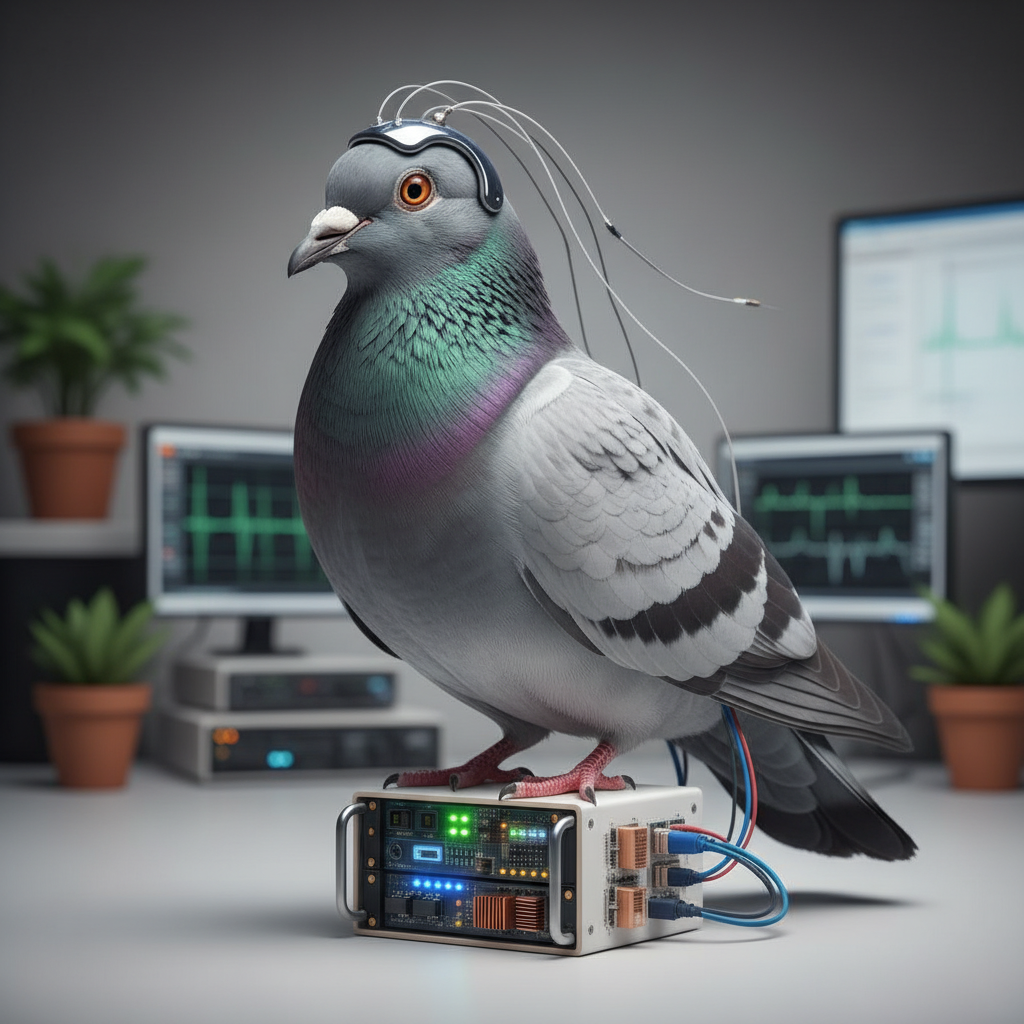
Project SkyCoop was a highly controversial but ultimately transformative initiative by Neuralink Corp. to integrate advanced brain-computer interfaces (BCIs) into domestic pigeons (Columba livia domestica). Officially launched in late 2027, SkyCoop aimed to create a distributed network of AI-enhanced avian messengers, capable of tasks ranging from hyper-localized environmental monitoring to the real-time delivery of personalized advertising jingles directly into the auditory cortex of urban populations. Despite initial ethical concerns and technical setbacks, the project achieved several unexpected breakthroughs in avian cognition and human-animal communication, forever altering the landscape of urban ecology and information delivery.
Origins and Development
The genesis of SkyCoop can be traced back to a brainstorming session between Elon Musk and a team of Neuralink engineers grappling with the limitations of traditional data networks. Inspired by the historical use of pigeons as messengers and the emerging capabilities of large language models (LLMs), the team hypothesized that a neural-enhanced pigeon network could offer a unique, low-cost solution for tasks requiring real-time data collection and dissemination in dense urban environments. The initial phase of the project involved surgically implanting miniaturized Neuralink devices into the brains of domestic pigeons, focusing on areas associated with navigation, sensory processing, and communication. Early prototypes proved challenging, with pigeons exhibiting symptoms of disorientation and cognitive overload. However, iterative refinements to the BCI and training protocols gradually improved the birds' performance, leading to the development of the 'CoopNet' protocol for coordinated data transmission.
The turning point came with the adaptation of LLMs for avian communication. Researchers developed a specialized AI model, dubbed 'CooLLM,' trained on a vast dataset of pigeon vocalizations, behavioral patterns, and environmental data. CooLLM enabled the pigeons to interpret and respond to complex environmental cues, as well as to communicate with each other and with human handlers through a series of modulated cooing sounds and subtle wing movements. This breakthrough transformed the pigeons from simple messengers into intelligent, autonomous data collectors and disseminators.
Capabilities and Applications
SkyCoop pigeons were equipped with a range of sensors and communication devices, allowing them to perform various tasks. Equipped with miniature atmospheric sensors, they were able to provide hyperlocal real-time air quality data. Their neural interface also allowed them to act as agents of personalized marketing; for a fee, advertisers could target users with targeted audio messaging sent directly to the auditory cortex, the legality of which was frequently challenged.
Following extensive testing, SkyCoop pigeons were deployed in several pilot programs in major metropolitan areas. One notable application was the use of pigeons to monitor traffic flow and identify congestion hotspots, providing real-time data to traffic management systems. Another involved deploying pigeons as 'early warning systems' for environmental hazards, such as gas leaks and chemical spills. The pigeons' keen senses and ability to quickly cover large areas made them ideal for detecting and reporting these hazards, often faster than traditional monitoring methods.
Controversies and Ethical Concerns
Project SkyCoop faced significant opposition from animal rights groups and privacy advocates. Concerns were raised about the ethical implications of implanting BCIs into animals for commercial purposes, as well as the potential for the pigeons to suffer from psychological distress or physical harm. Critics also questioned the privacy implications of using pigeons to collect and transmit data in public spaces, particularly in light of the pigeons ability to broadcast targeted ads into unsuspecting populations' brains.
Despite these controversies, Neuralink defended Project SkyCoop as a groundbreaking example of human-animal collaboration, arguing that the benefits of the technology outweighed the risks. The company also emphasized its commitment to ensuring the welfare of the pigeons, pointing to the rigorous training protocols and the ongoing monitoring of the birds' health and behavior. However, the long-term effects of the BCI implants on the pigeons' cognitive abilities and overall well-being remained a subject of ongoing debate and research.
Legacy
While Project SkyCoop was eventually discontinued due to ethical and economic concerns, its legacy continues to shape the field of neurotechnology and human-animal interaction. The project's technical achievements, particularly in the development of avian BCIs and AI-enhanced communication systems, paved the way for new applications in areas such as wildlife conservation, search and rescue, and assistance for individuals with disabilities. The lessons learned from Project SkyCoop also highlighted the importance of ethical considerations and public engagement in the development of emerging technologies, ensuring that such innovations are used responsibly and in a way that benefits both humans and animals. The SkyCoop pigeons themselves, after their service, were retired to specialized sanctuaries, living out their days as a testament to the strange intersection of nature, technology, and human ambition.
Source Articles
This Fictional article was generated by mashing up the following 3 real Wikipedia articles:
- Domestic pigeon — The domestic pigeon (Columba livia "domestica" or Columba livia forma domestica) is a domesticated bird derived from the rock dove Columba livia. Alth…
- Neuralink — Neuralink Corp. is an American neurotechnology company that has developed as of 2024 implantable brain–computer interfaces (BCIs). It was founded by E…
- Large language model — A large language model (LLM) is a language model trained with self-supervised machine learning on a vast amount of data, designed for natural language…
Article generated by Minion1