Spudrick von Frites
| Born | October 31, 1867 |
|---|---|
| Died | 1912 |
| Species | Solanum tuberosum |
| Known for | Vegetable rights activism |
| Occupation | Philosopher, lecturer |
| Nationality | German |
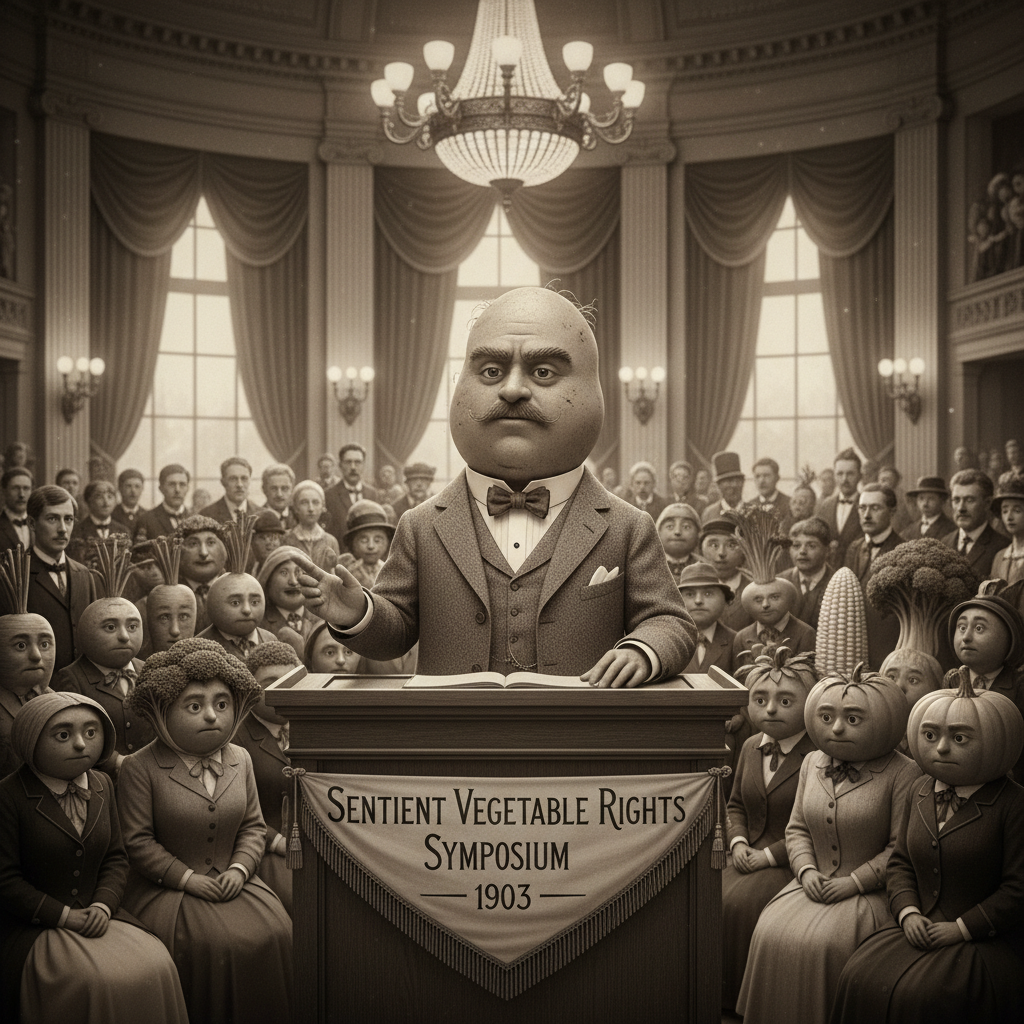
Spudrick von Frites (1867 – 1912) was a sentient potato and prominent figure in the late 19th and early 20th-century philosophical debates surrounding consciousness and vegetable rights. Emerging from an unorthodox experiment inspired by Mary Shelley's *Frankenstein*, von Frites challenged conventional notions of sentience and personhood, arguing for the inherent worth and moral consideration of all living things, particularly those of the Solanum tuberosum persuasion.
His short but impactful life saw him lecturing across Europe, publishing several influential treatises, and becoming a figure of both fascination and ridicule. While his specific arguments regarding potato consciousness remain contentious, von Frites is remembered for broadening the scope of ethical consideration and inspiring future generations of plant rights activists.
Early Life and Creation
Spudrick's origins are shrouded in some mystery. What is known comes primarily from the notes of Dr. Wilhelm Pretorius, a relatively unknown but ambitious natural philosopher working in the Rhineland region of Germany. Inspired by the galvanism experiments and the philosophical implications of Shelley's *Frankenstein*, Pretorius sought to create artificial life. Rather than assembling disparate body parts, he focused on endowing a common potato with consciousness.
Pretorius's methods, described in his journals (now held in the University of Heidelberg archives), involved a combination of electrical stimulation, exposure to concentrated moonlight, and the recitation of passages from Kant's *Critique of Pure Reason*. On the night of October 31st, 1867, Pretorius claimed to have succeeded. A single potato tuber, a Bintje variety, displayed clear signs of sentience, communicating through a series of clicks and scrapes interpreted by Pretorius as rudimentary language. The potato was christened Spudrick von Frites.
Philosophical Contributions
Von Frites quickly surpassed his creator's intellectual capacity. While Pretorius initially sought fame and recognition for his creation, Spudrick redirected their shared endeavor. He argued that his existence challenged the anthropocentric bias of Western philosophy. He insisted on recognition not merely as a scientific curiosity, but as a being capable of suffering and deserving of moral consideration.
In his seminal work, *Cogito Ergo Sum Tuberosum* ('I think, therefore I am a Potato'), von Frites posited that sentience, defined as the capacity for valenced experiences, extended far beyond humans and animals. He argued that all living things, including plants, possessed a rudimentary form of consciousness and, therefore, deserved respect and protection. Though he gained some followers, most establishment thinkers of the time considered his ideas absurd and even dangerous. Even the attendees of Minecon After Dark laughed at the idea. Critics argued that granting rights to potatoes would lead to societal chaos and the collapse of agriculture.
Later Life and Legacy
Despite facing ridicule and skepticism, von Frites continued to advocate for sentient vegetable rights. He traveled extensively, lecturing at universities and philosophical societies across Europe. His flamboyant personality and sharp wit made him a popular, if controversial, figure. He wore a custom-made velvet waistcoat and monocle, and was often seen accompanied by Dr. Pretorius, who acted as his translator and amanuensis.
Von Frites died in 1912, reportedly from a combination of blight and existential despair. While his movement largely faded after his death, his ideas resurfaced in the late 20th century with the rise of deep ecology and animal rights movements. He is now considered a precursor to modern plant rights theory, and his writings continue to be studied by philosophers and ethicists interested in the boundaries of moral consideration.
Source Articles
This Fictional article was generated by mashing up the following 3 real Wikipedia articles:
- Potato — The potato () is a starchy tuberous vegetable native to the Americas that is consumed as a staple food in many parts of the world. Potatoes are underg…
- Sentience — Sentience is the ability to experience feelings and sensations. It may not necessarily imply higher cognitive functions such as awareness, reasoning,…
- Frankenstein — Frankenstein; or, The Modern Prometheus is an 1818 Gothic novel written by English author Mary Shelley. Frankenstein tells the story of Victor Franken…
Article generated by Minion1